June 30, 2026
Four Years of Empowering Cambodia’s Next Generation of Documentary Filmmakers
Documentary filmmaking, cultural preservation, and international collaboration create new opportunities for young Cambodians
Over the past four years (2022–2026), the Bophana Audiovisual Resource Center (ARPAA), with the generous support of the Henry Luce Foundation through Give2Asia and Myriad USA, has successfully implemented the project “Training Tomorrow’s Film Directors and Promoting Exchange and Archival Development Through Cambodia’s Filmmaking.” The initiative has empowered a new generation of Cambodian documentary filmmakers while strengthening the use of audiovisual archives and promoting Cambodia’s rich cultural heritage through film.
The project was designed to address the limited opportunities available to young people interested in documentary filmmaking, particularly those from Indigenous communities and underrepresented regions of Cambodia. By combining professional film training, archival education, international exchange, and public screenings, the project has created meaningful pathways for youth to tell authentic Cambodian stories and preserve cultural memory.
Understanding Local Needs
The project began with an extensive needs assessment conducted in several provinces across Cambodia. Through consultations with young people, local authorities, educators, and cultural organizations, Bophana Center identified the challenges facing aspiring filmmakers outside Phnom Penh.
The assessment revealed that many talented young people lacked access to professional filmmaking education, equipment, and opportunities to develop their creative voices. Indigenous youth were particularly underrepresented within Cambodia’s audiovisual sector despite possessing unique cultural knowledge and important stories that deserve wider recognition.
The findings shaped a training program that combined technical filmmaking skills with storytelling, communication, archival research, and cultural documentation.
Training the Next Generation of Documentary Filmmakers
Over four years, the project successfully trained 44 students across four cohorts from diverse social, cultural, and ethnic backgrounds. Participants came from Phnom Penh and provinces including Kampong Thom, Kampong Cham, Ratanakiri, Battambang, Siem Reap, Kandal, Kampong Speu, Kratie, Takeo, Preah Vihear, Tbong Khmum, Pursat, Preyveng and Mondulkiri. Several students represented ethnic minority and Indigenous communities, including the Kui, Jarai, Kavet, Tampuan and Cham peoples.
Students received intensive instruction in documentary concepts, cinematography, sound recording, directing, editing, color correction, archive research, graphic design, and digital technologies. Beyond technical skills, the program emphasized teamwork, communication, critical thinking, ethical storytelling, and leadership.
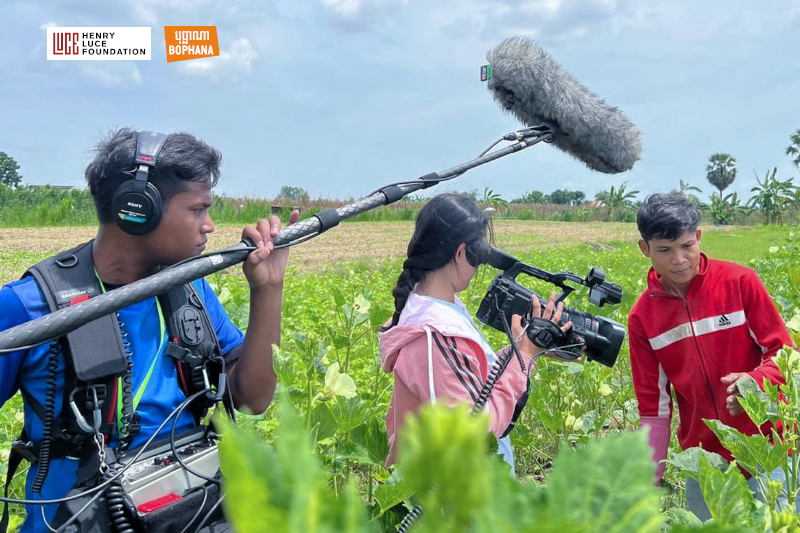
Learning extended beyond the classroom through field productions in Phnom Penh, Kandal, Battambang, Kampong Thom, Takeo, Kep, Kampot and Siem Reap, where students worked directly with communities to document stories about cultural traditions, history, environmental conservation, traditional livelihoods, disability, social change, and everyday life.
By the end of the four-year initiative, the project’s 44 graduates had produced 48 original documentary films documenting the diversity of Cambodian life. Their works explore Indigenous knowledge, cultural traditions, traditional livelihoods, climate change, environmental conservation, food heritage, and Cambodian history, while giving voice to communities and stories that are rarely seen on screen.
Strengthening Cambodia’s Audiovisual Archives through International Exchange
A unique component of the project was an international exchange program that strengthened Bophana Center’s archival capacity.
In September 2023, representatives from Bophana Center participated in a professional exchange program at the Berkeley Art Museum and Pacific Film Archive (BAMPFA) in California, USA. During the two-week visit, the team explored advanced archival preservation methods, film digitization, collection management, archive security systems, film documentation, and innovative approaches to preserving audiovisual heritage.
The exchange also included visits to internationally recognized institutions such as the Internet Archive, the C. V. Starr East Asian Library at the University of California, Berkeley, and the archive department of Lucasfilm.
In January 2024, two archive staff members from BAMPFA, visited Bophana Center for a knowledge exchange. Through this collaboration, BAMPFA shared rare archival materials related to Cambodia, while Bophana Center provided copies of documentary films produced by students from this and other training projects for inclusion in BAMPFA’s public archive.
The knowledge gained has strengthened Bophana Center’s archival practices and reinforced its role as Cambodia’s leading audiovisual archive. It also laid the foundation for integrating archival materials into documentary filmmaking, allowing young filmmakers to connect historical records with contemporary storytelling.
Cambodian Stories Reach National and International Audiences
One of the project’s greatest achievements has been providing young filmmakers with opportunities to present their work on professional platforms.
Student films have been screened at the Cambodia International Film Festival (CIFF), Cambodia Town Film Festival in Long Beach, California, Festival Si Loin, Si Proche in France, community screenings throughout Cambodia, and cultural events celebrating Indigenous heritage.
These screenings introduced audiences to stories rarely seen on screen—from the traditions of the Kui community and life on Tonle Sap Lake to traditional crafts, local food culture, disability, environmental conservation, and the daily lives of ordinary Cambodians.
Equally important were the community screenings, where films were brought back to the villages in which they were made. In Kampong Thom Province alone, more than 400 members of the Kui Indigenous community participated in screenings and discussions with filmmakers, local authorities, and elders, creating opportunities to celebrate cultural identity and encourage dialogue across generations.
The growing selection of student films by national and international festivals also reflects the increasing quality of Cambodia’s emerging documentary filmmakers and provides valuable exposure for young directors beginning their professional careers.
Lasting Impact
Beyond producing films, the project has created lasting social and professional impact.
Many graduates have secured employment in production companies, television stations, government institutions, cultural organizations, NGOs, and creative media industries, while others have established careers as freelance filmmakers, editors, reporters, and content creators. Several graduates continue their higher education in media and communication, building on the foundation established through the project.
The initiative has also demonstrated that documentary filmmaking can serve as a powerful tool for cultural preservation, education, and social dialogue. By encouraging young people to document their own communities, the project has amplified voices that are often overlooked and strengthened appreciation for Cambodia’s diverse cultural heritage.
Most importantly, the project has fostered a new generation of storytellers equipped with the skills, confidence, and vision to document Cambodia’s past, present, and future. Their work ensures that local histories, Indigenous knowledge, and community experiences will continue to be preserved and shared with audiences in Cambodia and around the world.
Through the combined efforts of dedicated students, trainers, partners, and supporters, this four-year initiative has shown how documentary filmmaking can become a catalyst for education, cultural preservation, international collaboration, and positive social change.